Managing a Bitcoin-Backed Loan: LTV, Repayment and Renewal
.webp)
Ledn has over $10 billion in loan originations since 2018 and counting!
Updated 9 September 2026
Managing a Bitcoin-backed loan is not just watching the price. You need to know which action you would take, where the funds would come from, and whether it can complete before the loan reaches a critical threshold or maturity.
This guide turns Ledn's LTV, Auto Top-Up and repayment rules into a practical management plan. The goal is to prepare while the loan is healthy, not assume that an alert will always leave enough time to act.
Check Ledn’s current loan terms and risk thresholds →
Set up the response before you need it
Record the current balance, collateral value and maturity date. Identify the account you would use for a repayment, the BTC available for a top-up and how long those transfers may take. Keep those resources separate from money already committed to another purchase.
Choose an internal review point before the provider's critical threshold. This is not a promise that any chosen buffer is sufficient; it is a way to avoid making your first decision under pressure.
If someone else will help manage a business or family loan, confirm their permitted authority. Do not rely on informal credential sharing or assume support can reverse a liquidation. Read the current agreement and account instructions before treating the loan as operationally ready.
Understand the LTV thresholds
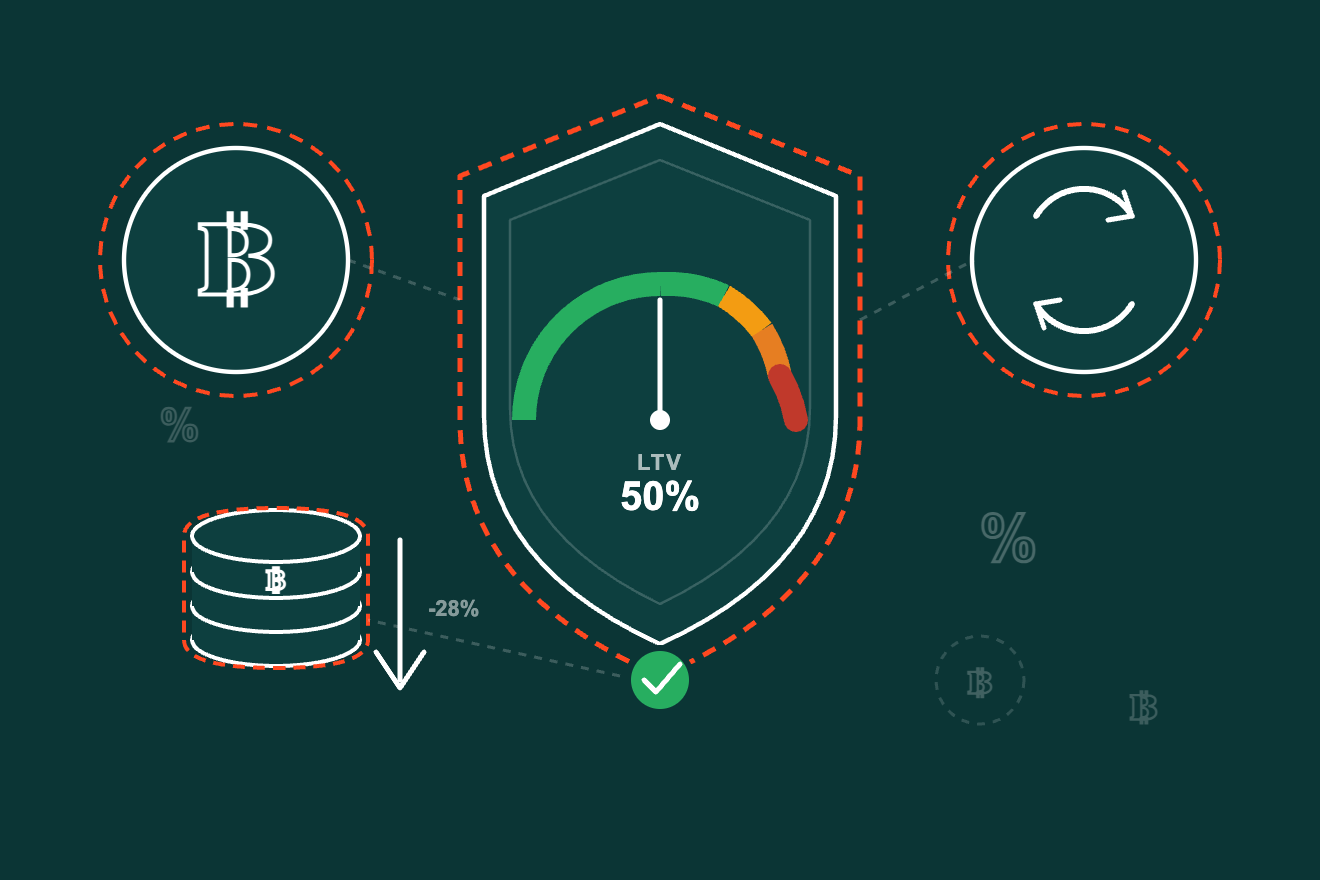
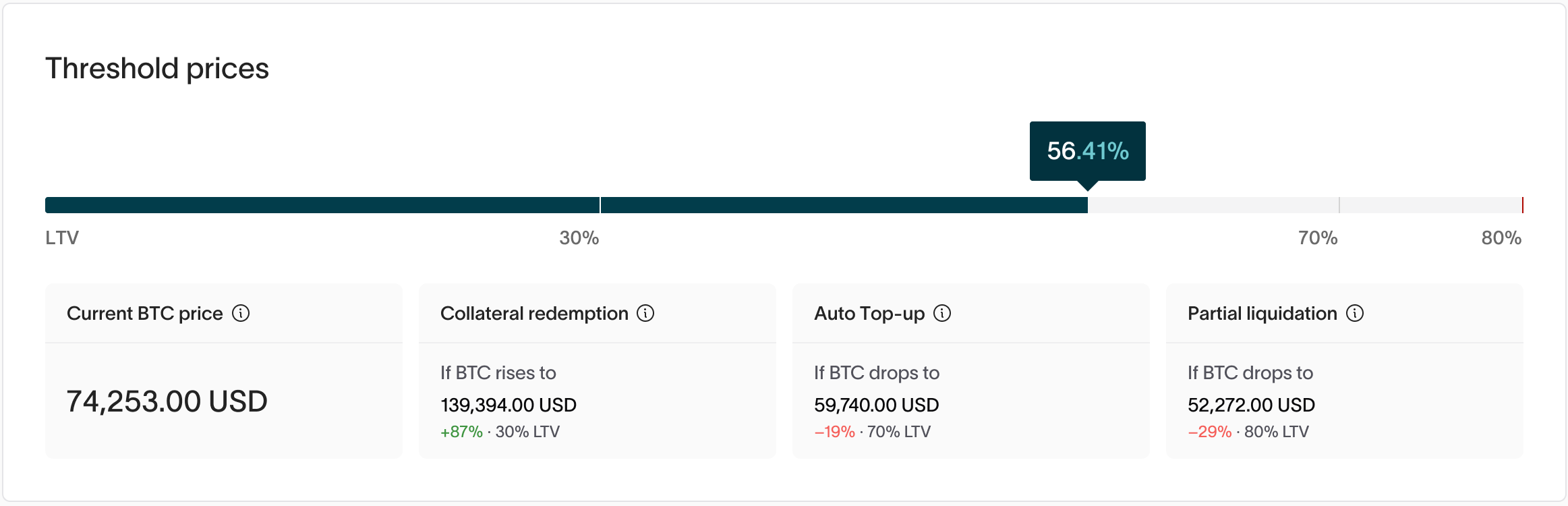
LTV is outstanding debt divided by current collateral value. Ledn's published guidance identifies notifications at 70% and 75% LTV and automatic liquidation at or above 80%. Notification delivery is not a guaranteed opportunity to act before a rapid market move.
For illustration, a constant $50,000 balance reaches 80% LTV when collateral is worth $62,500. Interest and fees can move that point. Monitor the actual platform balance and collateral value.
Enable Auto Top-Up with a funded reserve
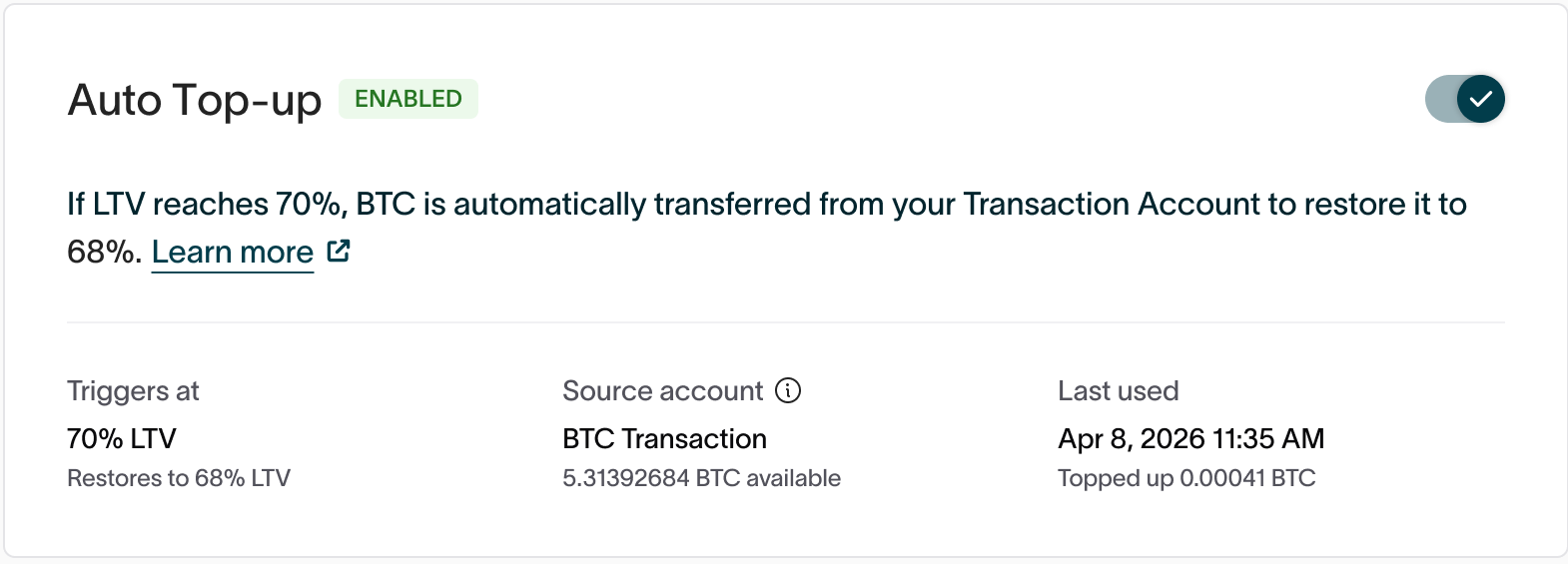
According to the Auto Top-Up Help Center guide, an enabled loan reaching 70% LTV uses BTC from the Transaction Account to target 68%. If the balance is insufficient, the available amount may be used without restoring the full target.
Check both portfolio-level and individual-loan settings. Enabling a switch without maintaining a reserve does not provide the same protection. Auto Top-Up reduces some operational friction but cannot guarantee that liquidation will be avoided.
Work out which resource changes the position
Take a hypothetical $50,000 balance against $80,000 of collateral: LTV is 62.5%. Repaying $10,000 from outside funds reduces the balance to $40,000 and LTV to 50%, assuming no other changes. Adding $20,000 of collateral instead leaves the $50,000 balance but also reaches 50% LTV.
Both improve the ratio in this simplified example, but only repayment reduces the debt. The top-up ties up more BTC; repayment uses other available funds. The calculation excludes accrued charges, fees and market movement, and a payment first covers applicable interest and fees before principal.
Use your actual platform values when deciding. Selling pledged BTC to repay changes both debt and collateral, so review its projected result separately.
Compare a top-up with a partial repayment
A top-up increases collateral while leaving debt outstanding. A partial repayment reduces the balance; the amount first covers accrued interest and fees before reducing principal. The right action depends on the assets available and your wider liquidity needs.
Bank transfers and blockchain transfers have processing times. Do not wait until the liquidation threshold to begin arranging funds. Follow the current repayment instructions in your account.
Plan for maturity using the current rules
Ledn's renewal guidance, updated 2 September 2026, says an eligible loan at or below 65% LTV renews under a new agreement. Above 65%, enough BTC is sold to reduce LTV to 64%, then the remaining balance renews. That sale reduces your BTC holdings and may have tax consequences.
Loans in ineligible jurisdictions do not automatically renew. If not repaid, they are liquidated at maturity with no grace period. Refinancing can be requested after 30 days and uses a new agreement and current terms. Neither renewal nor refinancing releases additional cash or collateral by itself.
Review the loan after a price recovery
A lower LTV does not automatically make all collateral withdrawable. Check current redemption conditions in your account. Withdrawing collateral increases LTV again and reduces the buffer against another fall.
Review after every material change
After a repayment, top-up, redemption or renewal, check the updated balance, collateral and agreement. Revisit the plan if your repayment source changes. Tools help execute parts of that plan; they do not replace it. Review Ledn's current borrowing terms alongside the account instructions.
This article is for general information, not financial, investment, tax or legal advice. Borrowing involves interest, fees and the risk of collateral liquidation. Eligibility and terms vary by jurisdiction and may change; the applicable agreement governs. Consult qualified advisers for your circumstances. Read Ledn’s Risk Disclosure Statement and Disclaimers.
The experts opinions:

CTA Block 1
Ledn was created by people who believe in Bitcoin’s power to revolutionise finance and build wealth reliably.
CTA ButtonCTA Block 2
Ledn was created by people who believe in Bitcoin’s power to revolutionise finance and build wealth reliably.
CTA ButtonCTA Block 3
Ledn was created by people who believe in Bitcoin’s power to revolutionise finance and build wealth reliably.
CTA ButtonCTA Block 4
Ledn was created by people who believe in Bitcoin’s power to revolutionise finance and build wealth reliably.
CTA Button